
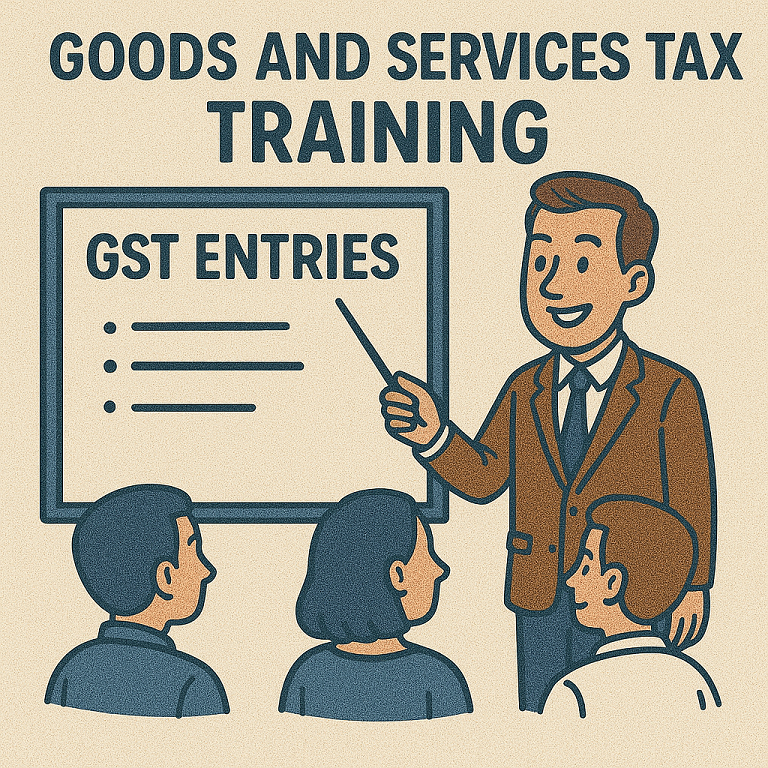
A GST trainer provides expert guidance on Goods and Services Tax concepts, registration, returns, invoicing, input tax credit, and compliance. They simplify complex rules with practical examples and hands-on training. By offering real-time case studies and updates, they help learners gain confidence to handle GST tasks efficiently in professional environments.
GOODS AND SERVICE TAX
COURSE FEATURES
- Individual Focus on each student
- 100% Placement Assurance
- 100% Practical Approach
- Affordable Fee's Structure
- Comprehensive Study Material
- Mock Exams
- Trained and Experienced Faculty
- Comprehensive Study Material
- Assignments , Notes and Mock tests
- Training Mode: Live online
- Affordable Fee's Structure
- Trained and Experienced Faculty
- Learn by Doing
YES, I AM INTERESTED
COURSE CONTENT
Goods and Services Tax (GST) is a comprehensive indirect tax introduced to simplify India’s complex tax system. It replaces multiple cascading taxes with a single, unified levy on the supply of goods and services. GST is designed to create a seamless national market, reduce tax evasion, and boost economic growth. It operates on a destination-based model, allowing businesses to claim input tax credits and ensuring transparency in tax collection across both central and state governments.
Goods and Services Tax (GST) is a comprehensive indirect tax introduced to simplify India’s complex tax system. It replaces multiple cascading taxes with a single, unified levy on the supply of goods and services. GST is designed to create a seamless national market, reduce tax evasion, and boost economic growth. It operates on a destination-based model, allowing businesses to claim input tax credits and ensuring transparency in tax collection across both central and state governments.
In GST, the place of supply concept is crucial for determining the tax’s destination and applicable rate. It identifies the location where a transaction is considered to occur, influencing whether CGST, SGST, or IGST applies. The rules differ for goods and services, ensuring correct revenue allocation among states. Accurate determination prevents disputes, enables smooth input tax credits, and facilitates compliance with GST regulations, thereby supporting an equitable and efficient tax system. Overall, it streamlines transaction.
Time of Supply in GST determines when a transaction occurs, triggering tax liability. It marks when goods or services are supplied, crucial for accurate reporting. For goods, it is the earlier of invoice date or payment receipt; for services, the earlier of invoice issuance or payment receipt. This concept ensures timely tax payment, proper input credit utilization, and GST compliance, supporting smooth business operations and revenue collection. Accurate determination prevents errors and ensures prompt filings.
Valuation of goods and services under GST determines the taxable amount on which the tax is levied. It includes the actual price paid or payable, plus additional charges such as packing, loading, and commission. Specific rules ensure that discounts, subsidies, and related-party transactions are treated fairly. Consistent valuation practices ensure transparency, compliance, and uniform revenue collection across states, fostering a level playing field for businesses while facilitating accurate tax liability and input tax credit adjustments
Input tax credit (ITC) mechanism in GST allows businesses to claim credit for tax paid on inputs, eliminating the cascading effect. By offsetting the tax liability on outputs against taxes paid on purchases, ITC ensures tax is levied only on the value addition. The system enhances compliance, reduces production costs, and promotes competitive pricing. Businesses must maintain proper documentation and follow strict eligibility rules to claim ITC and facilitate smooth tax reconciliation, ensuring financial stability .
The reverse charge mechanism in GST shifts the responsibility of tax payment from the supplier to the recipient. Under this system, the recipient is liable to pay GST directly to the government. This mechanism applies in specific circumstances, including certain notified goods and services transactions, or when dealing with unregistered suppliers. It significantly ensures tax compliance, broadens the tax base, and reduces evasion risks. Businesses must carefully assess applicability to avoid non-compliance and potential penalties..
The e-way bill is an electronic document required for the movement of goods valued above a specified limit under the GST regime. It captures details of the consignor, consignee, and goods being transported, ensuring seamless tracking and reducing tax evasion risks. Mandatory across states, the e-way bill system promotes transparency, efficient transportation, and smooth tax administration. Timely generation of this document helps businesses avoid penalties and facilitates uninterrupted logistics operations, ensuring robust legal compliance nationwide.
GST calculations involve determining the tax liability on goods and services transactions. Businesses compute GST by applying the appropriate tax rate to the taxable value and dividing the tax into central (CGST), state (SGST), or integrated (IGST) components based on transaction nature and destination. Adjustments for input tax credits, exemptions, and reverse charge scenarios are considered to avoid errors. GST calculations ensure compliance, facilitate proper credit utilization, and support a transparent, efficient tax collection system. .
.
GST payment is a crucial process in the Goods and Services Tax system requiring businesses to remit tax liabilities promptly and accurately. Tax amounts, calculated from sales and input credits, are paid online via government portals using electronic challans. Timely GST remittance ensures legal compliance, prevents interest and penalties, and facilitates smooth credit adjustments. This efficient mechanism supports transparent revenue collection and contributes to a robust fiscal framework that sustains economic growth across the nation
GST interest and penalty are financial charges imposed for non-compliance with tax regulations under the GST regime. Interest is levied on delayed tax payments, calculated on the outstanding amount over the specified period, ensuring timely remittance. Penalties, varying based on the nature and severity of non-compliance, aim to deter fraudulent practices and encourage prompt filing. Both interest and penalty serve as corrective measures, reinforcing accountability and adherence to statutory deadlines and requirements, ensuring strict compliance
GST registration is a process by which a business or individual becomes a registered taxpayer under the Goods and Services Tax system in India. It allows collection of GST from customers and claim of input tax credit. Registration is mandatory for businesses exceeding the specified turnover limit.
GST returns are documents that registered taxpayers must file to report their business transactions, including sales, purchases, and tax paid. Common returns include GSTR-1 for outward supplies and GSTR-3B for monthly summaries. Filing returns on time ensures compliance and allows businesses to claim Input Tax Credit. Returns can be filed online through the GST portal. Timely and accurate filing helps avoid penalties and keeps the business GST-compliant. It is essential for smooth tax administration.
ABOUT FACULTY
STUDENT TESTIMONIAL

"I am working professional. To upgrade my skills I took training on Taxation. Excellent training."
- Radha Krishna
"I Am Kumar From Visakhapatnam. I Am Taking Practical Accounts Training from Ramesh Sir."
- Krishna Kumar
"One of the best institute in Hyderabad. I am very thankful to Ramesh Sir for inspiring both professionally and personally."
- Prabhakar
"Best way to learn Accounting in this institute. Thank you for guiding me professionally and personally."
- Rajesh Kumar
"Best Institute to get practical knowledge with high care and attention. Concepts are explained multiple times until perfect clarity."
- Madhusudhan
CERTIFICATION
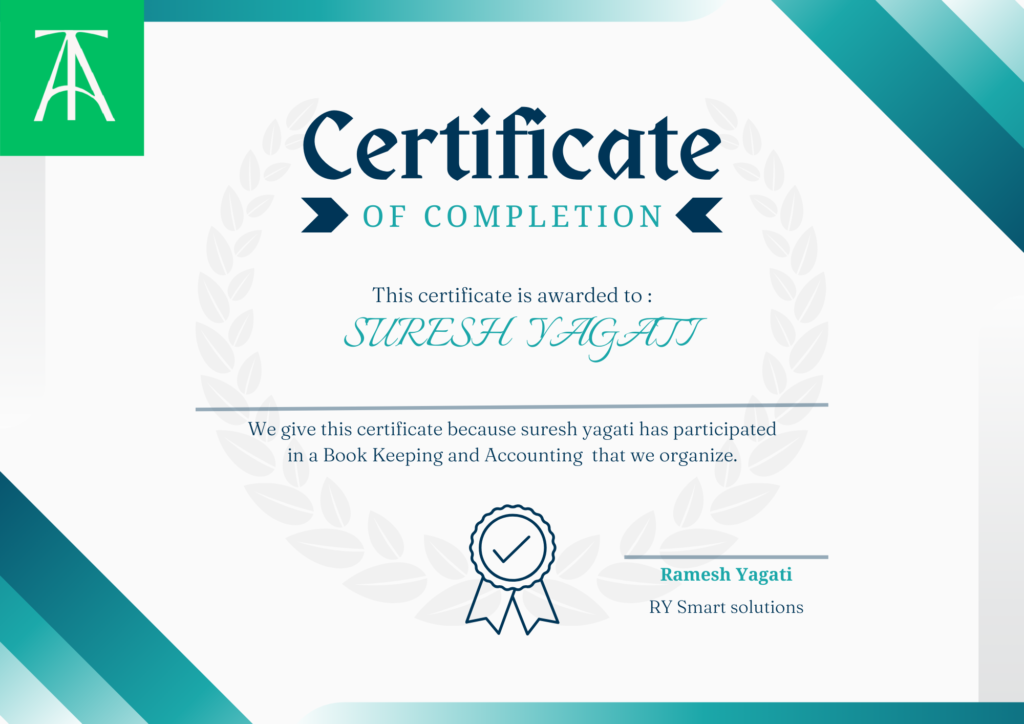
After successful completion of the GST training course, participants receive a GST Certification that validates their practical knowledge of Goods and Services Tax. This certification demonstrates proficiency in GST registration, invoicing, returns filing, input tax credit, payment procedures, and compliance requirements. It enhances credibility for accounting professionals, tax practitioners, entrepreneurs, and job seekers in finance roles. The certification also boosts employment opportunities in organizations that require GST filing and compliance support. With hands-on skills in Tally, GST portal usage, and real-time calculations, certified candidates are better equipped to handle day-to-day GST operations efficiently and confidently in business environments.
FAQ's
Can I file a GST Return After Completion of this GST Course?
We are teaching you from basics to advance level including GST return filing. We teaches you on a real case basis on the GST portal so that you have a confidence to file GST return on your own.
Who can do this course?
If your accounting concepts are clear and doing job in accounting then to grow and enhance at upper level, it is advisable to do this course. If you want to start as a fresher then it is advisable to go for accounting and tax professional courses.
Do you teach how to take GST registration?
Tag line of our course is No Books…. Only practical…. We teaches you all aspects of GST in details which will be used in corporates. It also includes GST registration which help you to work as a tax practitioner.
Will I get practical exercises and case studies?
Yes. The course includes real-life business examples, transactions, and step-by-step exercises to help you gain practical bookkeeping experience.
Will I receive a certificate after completing the course?
Yes, upon successful completion of the training and assessment, you will receive a Manual Bookkeeping Training Certificate recognized by our institute.
What is the cost of a GST course?
GST courses typically cost between ₹2,000 and ₹10,000, depending on the syllabus, course length, and the institution. We provides one of the most cost-effective GST training courses offering 100% placement support.
What is the salary of GST course per month?
With an average pay of ₹25,000 per month, the estimated monthly total compensation for a GST Executive is ₹28,000.
Is GST course useful?
A GST course is unquestionably a wise decision if you want to work in accounting or finance. It helps you stay current in the competitive job market, enhances your employability, and equips you with the necessary skills.
OTHER COURSES